March 25, 2021
PNW wheat industry offers congressman feedback on dam proposal
The wheat organizations of Idaho, Oregon and Washington have collaborated on a letter to Idaho Rep. Mike Simpson offering feedback on his proposal, including clearing up some misconceptions espoused in the plan and in Simpson’s comments since he released it, including the fact that Washington farmers use water from Idaho to “compete” with Idaho farmers.
Representative Simpson:
On behalf of 12,000 farm families who raise wheat from Idaho Falls to Bonners Ferry and across northeastern Oregon and eastern Washington, we thank you for participating in the recent virtual meeting organized by the Food Producers of Idaho. We appreciate you taking the time to discuss your concept of removing the lower Snake River dams and the substantial monies you indicated would be necessary to offset the impact it would have. You encouraged participants to share ideas and information with you. Our four wheat-grower organizations would like to take the opportunity to clear up the following misconceptions first:
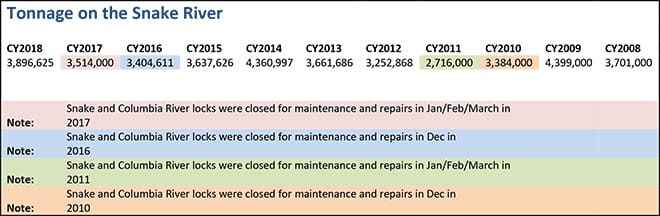
- It is incorrect to state that downriver barge shipments have declined. The millions of tons of grain barged downriver have remained relatively stable, year after year. Other shipments have increased dramatically—upriver shipments of fertilizer, starting at zero several years ago, now are necessary to provide growers on the Camas Prairie, the Palouse and beyond the timely deliveries trains and trucks cannot—with more than a million acres of land to be fertilized and seeded in short order to achieve best yields at harvest time. The chart below shows the actual tonnage figures for the Snake River from 2008-2018. 2018 is the last published year from U.S. Army Corps of Engineers & U.S. Customs, who report tonnage on federal waterways nationwide.
- It is not accurate to state that barging can be replaced with cheaper alternatives. Trucks and trains produce more greenhouse gases in transport up and down the river, are more expensive, and far less reliable. In 2017 the Lewis-Clark Grain Terminal in Lewiston shipped more than 20.6 million bushels of wheat and barley to international markets. Without an economic and timely way to move more wheat to foreign buyers, these bushels would instead glut the domestic market and harm the export trade so critical to the Northwest economy.
- Your conclusion that, “Washington grain farmers can take that water [used to help move salmon downriver] to irrigate their grain and compete against our [Idaho] farmers” is incorrect. Grain raised in the Palouse and on the Camas Prairie depends upon timely rains. In the irrigated lowlands of the Columbia Basin, wheat is raised sparingly as a rotational crop. The ‘surge’ of water to hurry along smolt has nothing to do with irrigating the crops that are grown there. Those who participate in the voluntary flow augmentation program are compensated by the Bureau of Reclamation—helping offset operations and maintenance costs, thereby lowering the cost of water to Idaho’s farmers.
- Wheat growers in our four Northwest states do not spend much time competing with each other. Our biggest challenges and opportunities are overseas, around the Pacific Rim and elsewhere and our competitors are Australia, Canada, and other countries. We have worked for generations as tri-state wheat producers to seek new trade opportunities overseas for the classes of grain we raise.